Laser safety management
course notes
Light fundamentals
Light is a form of energy and when talking about safety, we sometimes refer to it as optical radiation. It can be described as rays, particles or waves. For our purposes, describing light as waves will be the most helpful.
For light, the wavelength defines the colour and is summarised in the table below. 1nm = 1,000,000,000th of a metre.
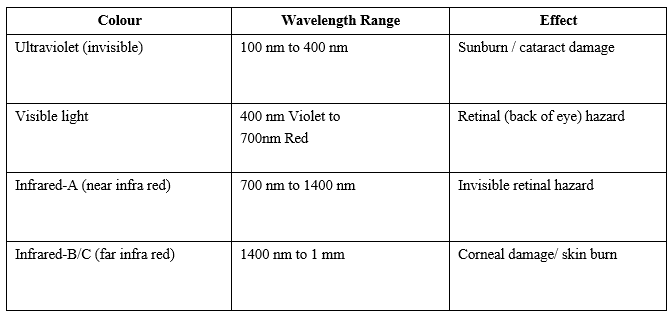
It is useful to know the wavelength for the following reasons;
- Indication of the hazard/risk
- Calculating the damage threshold (eyes and soft tissue)
- Determining whether a laser beam is visible or invisible
- Protective eyewear selection

Lasers and IPLs - physical characteristics
Laser light
Laser light is a typically an intense beam of optical radiation. It is different from all other light sources in the way it is generated. Typically laser light exhibits the following properties:
- Single colour (monochromatic)
- Collimated (non divergent)
The second property can be seen in the example of a laser pointer. The size of the spot does not spread out in the same way the light from a traditional handheld torch would. This unique property means that whilst the power of a laser may one hundred times lower than a household light-bulb, the beam can be hazardous at a distance of hundreds of meters away from the source.
Lasers are typically named according to their laser medium. This is the material that sits inside a cavity in a laser machine where the laser light is generated. Each laser medium emits light of a characteristic wavelength.
Some examples of lasers are listed below.
Carbon Dioxide
The laser medium in this case is a gas. The laser light produced is in the far infra red region (10600 nm)
Nd:YAG
The Neodymium: Yttrium Aluminium Garnet laser is 'solid state' in that it does not use a gas but rather a crystal as the lasing medium. It produces 1064 nm wavelength light (near infrared) which is invisible. A crystal can also be used to 'half the wavelength' to 532nm (green).
Excimer
The excimer laser uses an 'excited dimer' lasing medium. For example the Argon Fluoride (ArF) emits in the UV region (193 nm) and is used in corneal sculpturing (laser eye surgery).
Solid State (diode)
This is a special form of light emitting diode, familiar on electronic equipment. They are very efficient (up to 50%) so that little cooling is required. Wavelengths from 630 - 2100 nm are available.
Difference between Laser and 'normal' light sources
A comparison between the properties of the light is given below.
Laser light = single colour (monochromatic)
normal = broad spectrum (polychromatic)
Laser light = can be collimated so that it does not diverge for hundreds of meters
normal = diverges very quickly
Biological interaction
When intense light from a laser or other intense source of sufficient energy is direction onto the tissues of the body, the effect varies depending upon the timescale with which the energy is delivered. This can be broadly categorised under three headings.
Photo-mechanical and Acoustic effects (less than microseconds)
Energy is deposited as a shock wave and results in physical disruption and cell rupture, in a short period of time - the effect is very localised. The technique is used in Ophthalmology, Lithotripsy (for the fragmentation of stones in situ) and for tattoo removal.
Thermal effects (less than milliseconds to several seconds)
The energy is absorbed by cell molecules. This leads to an increase in temperature of the cell and adjoining cells which show burn characteristics and tissue damage due to protein denaturation (above 60C). Above 100C the tissue vaporises and at about 350C burns. This is the most common effect used in medicine and is used for thermal shrinkage (sealing small blood vessels) or for tumor removal (either by surgical cutting or total ablation of tissue). Most hair reduction techniques also make use of thermal effects.
Photochemical effects (greater than several seconds)
Low level intensity light is used to activate the cell or administered chemical molecules. The response is very wavelength dependent and is used in Physiotherapy lasers and for Photodynamic Therapy. The effect can result from a single long exposure or multiple short exposures.
|
Revision Questions 1. Put simply, what property of light does wavelength define? 2. How does laser light differ from 'normal' light? 3. Why is is useful to know the wavelength? |


