Laser safety management
course notes
Hazards and risks
We will define a HAZARD as, something that can cause harm.
And RISK as, the probability of the hazard causing harm and the severity of that harm.
For example the laser machine is the hazard and the risk is the likely-hood of damage to the eye and skin from the light emitted from these machines.
Risk to the skin
Relatively speaking this is not usually a significant hazard, because the damage is likely to be superficial and will probably heal in time.
Risk to the eye
The eye is at particular risk for the following reasons:
- Damage to the retina (back of the eye) is likely to be irreparable
- Damage can occur at large distances from the laser aperture
- Damage can occur from exposure to very low power lasers
- Even reflections can be hazardous
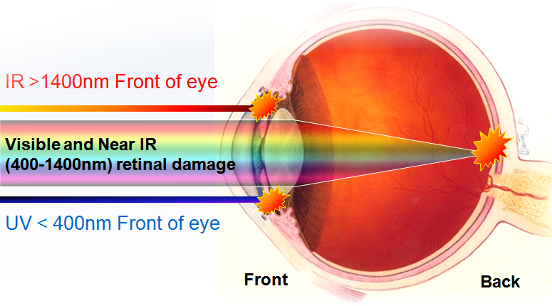
The area of the eye that is susceptible to damage is dependent on the wavelength of the laser or intense light source.
Retinal damage (back of the eye)
Exposure to visible and near infra red light can cause permanent blindness.
Even light of relatively low energy can be a hazard to the retina. This is because the lens of the eye focuses light onto a very small point at the back of the eye which greatly increases the intensity. Low power lasers of even a milliwatt can be dangerous.
Only a fraction of the energy is directly absorbed by rods and cones, the remainder being absorbed by melanin in the epithelium. This causes local heating and hence indirect damage to adjacent rods and cones.
If sufficiently intense, this may result in permanent loss of vision, which will be noted by the subject only if the macula is involved. This is likely to occur if the subject was looking directly at the beam. Peripheral loss will only be noted with gross damage or maybe by an ophthalmic examination.
Anterior (front of eye) damage
Very short (less than 315 nm) and very long (more than 1400 nm) wavelengths are absorbed in the cornea. If the damage is superficial and limited to outer layers, then the cornea will repair itself due to fast turnover of surface cells. Some wavelengths (315 to 400 nm and 760 to 1400 nm) will deposit some of their energy in the lens of the eye. This could lead to cataract formation if the energy is sufficiently high.

Risk Perception
With 'normal' white light sources, the brightness we perceive broadly relates to the risk the source presents. However, with laser light we cannot always judge the hazard visually. For example, laser light in the region 700-1400nm is invisible, yet even low levels can cause damage to the retina of the eye. In addition, our vision is relatively sensitive to green light, so we might be naturally cautious of a green laser. However, a red or violet laser beam would appear dull by comparison but present a very similar risk to the eye.
Non-Beam Hazards
As well as the direct risk from the intense light beam to the eyes and skin, the use of laser equipment may pose other dangers.
Laser Generated Airborne Contaminants (Laser Plume)
When target material exposed to the air is 'lased', a large amount of material can be ejected into the air. this may include toxic materials or biological matter that may pose a health risk.
High Voltage
Access to high voltage (HV) is normally via special panels. Any faults with the machine should only be rectified by trained staff. In particular it should be noted that with some lasers the capacitors remain charged for a considerable period, even after the laser has been switched off, and are capable of delivering a lethal shock.
Fire risk
Many lasers are capable of setting fire to flammable materials and represent a fire risk.
Chemicals
Some lasers use toxic liquids and gases which can even be fatal even at low concentrations.
Slips trips and falls
Trailing wires are a common example of this type of hazard.
Who is at risk
It is sometimes helpful to broadly categorise the various 'at risk groups'. These may include:
- Staff,
- Visitors,
- Members of the public.
Risk Assessment
The risk assessment is a process designed to identify any hazards, quantify the risks from those hazards and look at appropriate safety controls that may need to be put in place. The risk posed by the laser will vary depending upon a number of factors such as;
a) Wavelength of the laser,
b) Output of the laser (maximum power or energy),
c) How the laser is used,
d) The activity.
In essence we want to find out if it is possible to be exposed to a laser beam of sufficient intensity to cause damage (to the eye or skin). We then would decide if there is a reasonable probability of this happening.
Safe Distance
With almost all laser applications, at source, the beam will exceed the safe intensity (known as the Maximum Permissible Exposure) and will present a hazard.
However, the beam will then diverge to some extent and at some point the intensity will be low enough for the beam to become safe. The distance at which this happens is known as the Nominal Ocular Hazard distance (NOHD).
This hazard distance can be calculated if factors such as the output, divergence and aperture size are known. However, with modern medical laser equipment, this information can usually be obtained from the equipment supplier/manufacturer and is often listed in the user manual.
Knowing the hazard distance will help us decide whether certain controls are needed to ensure the laser light does not escape the confines of the area. Window coverings may be needed if the NOHD is larger than the room dimensions for example.
Protective eyewear (laser)
If protective eyewear is needed, we will also need to know what level of protection is required. Historically, this is usually taken to be the level of attenuation needed to make the laser 'safe' at a distance of 0.1m from the beam and is expressed as an 'optical density'. Again, the eyewear specification will almost certainly be described in the equipment manual.
Sources of initial information?
Details such as equipment specification, hazard distance and eyewear specification can be obtained from a number of sources;
a) Safety adviser (e.g. laser protection adviser),
b) Equipment supplier,
c) Equipment manufacturer,
d) User manual and training materials,
e) Equipment labels.
Who can carry out the risk assessment?
Any competent person can lead the risk assessment process. However, we usually to refer to the 'risk assessment team'. This may include;
a) Safety adviser (e.g. laser protection adviser),
b) Laser operator(s),
c) Manager.
Documenting the risk assessment?
In UK law, the significant findings of the risk assessment must be documented if the business employs five or more people. It is generally recommended that the risk assessment is documented regardless though, as otherwise there may be no evidence that a risk assessment has actually been done.
When should the risk assessment be revisited?
The risk assessment should undergo review;
a) Periodically,
b) Following any significant changes (laser, facility, activity),
c) Following any incident, d) Following any relevant changes in legislation.
|
Revision Questions 1. Why is laser light in the region 400-1400nm particularly dangerous? 2. What do we mean when we say we can't judge the laser hazard visually? 3. What do we mean by 'non beam' hazards? |


