Laser safety management (medical and cosmetic applications)
'Core of knowledge' course notes
Safety Controls
The risk assessment will determine the most appropriate controls to effectively manage the risks from intense light. Examples of typical controls are listed below.
Written policies and procedures
Written procedures form part of the training system and help ensure a consistent working practices.
Designation of a "controlled area"
The controlled area is the area in which it is possible for intense light to cause harm. In medical and cosmetic applications, it is typical to designate the treatment room or theatre as a controlled area. Note that this only applies when the hazard is present (i.e. the machine is on). Many of the controls below are introduced to,
a) Manage the risks to the operators and patient/clients in the controlled area
b) Prevent harmful levels of light escaping the controlled area
c) Prevent unauthorised access to the controlled area
Laser guards
The first method to manage the risks from laser light is to fully enclose the beam if possible. This effectively turns the system into a class 1 (safe) product. Ideally, guards should be interlocked.
Beam termination 'stops'
Ensure that the beam terminates on a non reflective and laser resistant surface.
Remote (room door/barrier) interlocks
Shut the machine down upon unauthorised entry
Laser blinds or curtains
To create a barrier around the laser if it is used in a large open environment such as the factory floor.
General design features of the machine
Design features of the machine may only allow exposure in certain directions for example. Other features may include a key (or pin) control to prevent unauthorised access, shielded optical fibres and emergency stops.
Training and instruction
Trained competent staff are absolutely vital and also a legal requirement. The provision of training and instruction can be achieved in a number of ways.
Workplace culture
Maintaining a good health and safety 'culture' in the workplace is important.
Safe working practices
Again, established safe working practices and clear policies and procedures are an effective control.
Measures to confine the light to the room
May include blinds/covers on windows, addressing double door gaps etc.
Warning signs
Placed at the entrances to a defined area, these deter unauthorised entry. Illuminated signs can also be connected to the laser power supply, which activate automatically when the laser is in use.
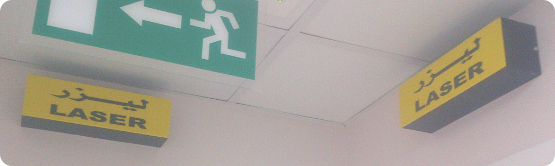
Example of illuminated warning signs. Note the difficulty in positioning these at eye level.
Plume controls
Smoke plume evacuators and face masks.
Personal protective equipment (PPE)
Eyewear, gloves and face masks.
Control of access
Controls may include, warning signs, barriers, door interlocks etc. Consideration may be given to locking of doors.
Eyewear
Whilst most industrial users of lasers manage to enclose laser beams, there are some activities (e.g. service, field-work) where we must resort to protective eyewear.
Eyewear should be:
- CE marked
- In a good state of repair
- Stored correctly
- Kept clean and hygienic
- Offer an appropriate level of attenuation at the appropriate wavelength(s)
It is a legal requirement that staff should be trained in the correct use of the eyewear. Typically, eyewear labeling is not user friendly and this carries a significant risk of using the wrong type.
Laser Eyewear
Laser eyewear is wavelength specific. It is therefore very important that firstly, the correct eyewear is obtained and secondly, where different lasers are used, measures are taken to prevent accidentally using the wrong ones. These measures may include extra labeling and separate storage. Staff training should feature in these controls.
Visibility with laser eyewear is good, as only a small part of the visible spectrum needs to be blocked out.
Laser eyewear is usually tested to an appropriate standard (BS EN 207).
Broad Spectrum Eyewear
Broad spectrum (intense 'non-laser' light) eyewear is potentially problematic. Blocking against all visible light impairs vision (similar to wearing sunglasses indoors).
It is common to use 'welding shade' eyewear in these cases.
These do not offer anywhere near the attenuation of laser goggles (which often reduce the laser light by a millionth!) and instead block out the light to the same degree as dark sunglasses (~60%).
Warning signs
These may be placed on or near equipment, barriers or on doors. Ideally, signs should be displayed at eye level.
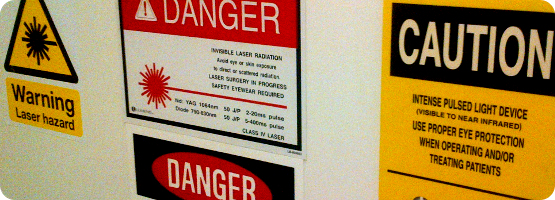
Signs affixed to a cosmetic laser treatment room door. This is not ideal as the hazard is not present all the time.
Illuminated warning signs can be wired so as to light up when the laser is switched on. These have the advantage of being visually striking and only activated when there is an actual hazard. Modern illuminated warning signs tend to use LEDs which greatly reduces the need for routine 'broken bulb' checks.
In cases where eyewear is stored outside the room, blue "eyewear must be worn" signs can be displayed on the outside of the entrance.
Under the Health and Safety (Safety Signs and Signals) Regulations 1996, the following is required:
- Signs are maintained in good condition
- Comprehensible and relevant information on the measures to be taken in connection with safety signs is provided to employees.
- Employees receive suitable and sufficient instruction and training in the meaning of safety signs and the measures to be taken in connection with safety signs.
- The effectiveness of a sign must not be adversely affected by placing of too many signs too close together.

Written safety procedures
These could be integrated into the Safe System of Work and include information such as,
- Description of the hazard
- Definition of a designated working area
- Key contacts/personnel
- Key safety instructions
- Correct use of Personal Protective Equipment (PPE)
- Meaning of signage
- Emergency procedures
- Refer to specific operating procedures for the actual activity
Some general tips are given below for anyone writing a laser safety procedures.
1. Identify the target readership and the key safety points you want them to take on board.
2. Where possible, aim to cover all rooms and lasers into a single concise document.
3. In the same way, aim to standardise the controls. For example whilst it isn't strictly necessary to cover windows for CO2 lasers, it may be less confusing to include this as a universal control.
4. Ensure that understanding is checked rather than ask staff to just read and sign.
5. Use plain English and avoid specialist terminology and acronyms as much as possible.
|
Revision Questions 1. Why are 'engineering controls' preferable to administrative controls and PPE? 2. What practical controls might you take to help reduce the risk of mixing up the eyewear? 3. Why is it difficult to protect against broad spectrum light sources with eyewear? |


