Laser safety management
course notes
Maximum permissible exposure
Various exposure data has been analysed and international safety committees have been able to publish levels of intense light above which it is deemed that harm will occur.
The Maximum Permissible Exposure (MPE) is defined as,
The level of optical radiation to which, under normal circumstances, persons may be exposed without suffering effects.
The MPE varies depending upon;
a) Wavelength of light
b) Duration of exposure
c) Beam intensity
d) Target tissue (eye or skin)
MPE figures are typically given in terms of energy or power density.
Hazard Distance
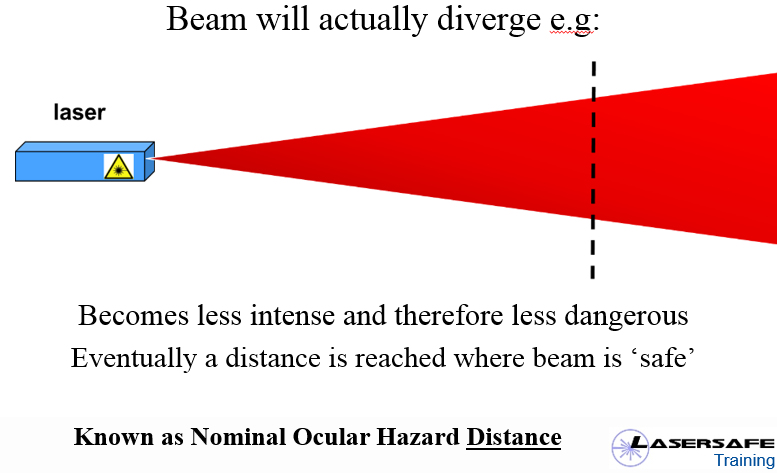
All light sources spread out as they propagate away from their origin. At a certain distance the intensity of the light will not be strong enough to cause damage to the eye. This distance is known as the Nominal Ocular Hazard Distance (NOHD).
A technical definition of the NOHD is,
The Minimum distance from the light source at which the exposure to the beam falls below the Maximum Permissible Exposure (MPE)
This is useful when determining the safety controls of a particular facility. It may be of the order of a few centimetres (low power communications lasers) or tens of meters. It is mainly determined by the divergence of the beam but wavelength, duration of exposure and output power all have an effect.
|
Revision Questions 1. Which wavelengths (colours) are most dangerous to the eye (see page 2)? 2. Would you expect the MPE to be relatively lower or higher at these wavelengths? 3. Why is useful to know the 'hazard distance'? |


