Laser safety management
course notes
Safety Standards
There are many standards applicable to those using laser equipment. The most relevant ones are listed below.
Laser equipment
BS EN 60825-1:2014 Edition 3, Safety of laser products, IEC 2014
This document contains values for "maximum permissible exposures" (MPE) for the eye and skin. Exposure to laser light above these values will result in harm. Worked examples of Nominal Ocular Hazard Distance (NOHD) are also included in this standard.
The laser classification system is also introduced here. There are several "classes" of laser ranging from class 1 (safe, e.g. laser in CD player) to class 3B and 4 (used for laser marking/cutting for example).
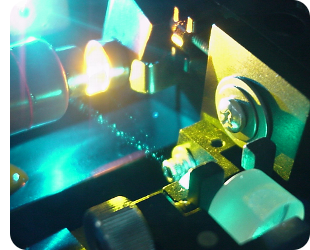 Class 3B
- normally hazardous for direct beam exposure
- viewing diffuse reflections is normally safe
- output lower than 500mW
Class 4
- can produce hazardous diffuse reflections
- may cause skin injury
- potential fire hazard
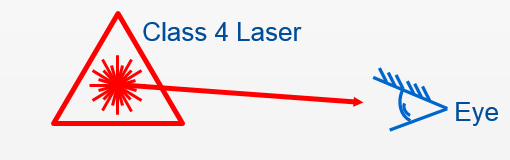
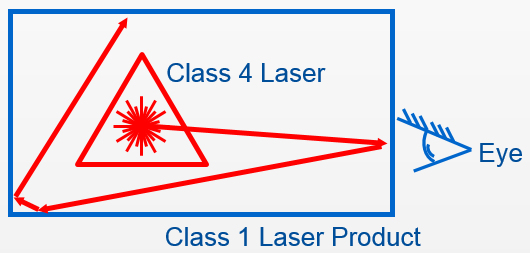
Class 3B and Class 4 lasers represent a significant risk to the eye and skin. In most applications, the goal is to eliminate the chance of exposure to the laser beam. This effectively leaves us with a CLASS 1 LASER PRODUCT (safe).
See also: Guide to classification of laser equipment (BS EN 60825)
Eyewear standards
Standards also exist for safety eyewear:
- BS EN 207 and BS EN 208 for laser eyewear
The laser standard can be confusing for the layman and has even been described as counterproductive. However, in light of reports of dubious imports, it does at least guarantee some level of quality and assurance for the user.
Basic guide to understanding eyewear markings
From BS EN 207:2009 Personal eye-protection equipment. Filters and eye-protectors against laser radiation (laser eye-protectors) Traditionally, laser eyewear was defined by the following,
- Wavelength or wavelength range the eyewear filters were suitable for
- The amount of attenuation they offered, stated as Optical Density (OD)*
- Visible light transmission (VLT), level to which they block all ambient light
*Optical density is a logarithmic scale, i.e.
OD 1 attenuates light by 10 times
OD 2 attenuates light by 100 times
OD 3 attenuates light by 1000 times and so on.
However, this does not take into account the capability of the laser beam to physically damage the eyewear. To address this, scale numbers were introduced in the 207 standard.
The downside of this as that eyewear markings are not straightforward and can be confusing, even to those working with lasers.
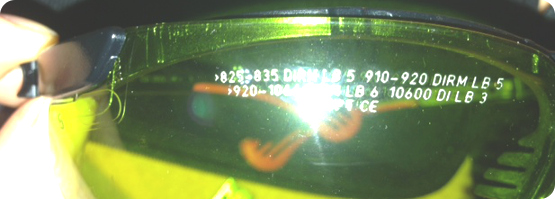
e.g. 532 D LB6 X CE
D = continuous output (see table below)*
532 = offers protection (tested) at a wavelength of 532nm (green)
LB7 = scale number (protection level) 7
X = manufacturer ID
CE = CE Marking (conforms to directive CE 89/686/CEE)
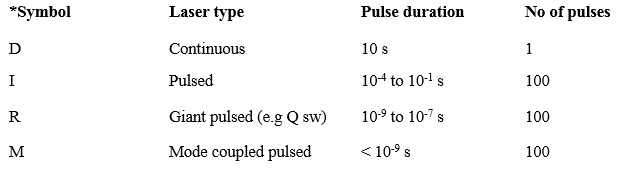
The above example is relatively basic and often the eyewear is tested at several wavelengths. This can result in several lines of detailed markings on the eyewear filters.
|
Revision Questions 1. What are the differences between a class 3B and class 4 laser? 2. How can we turn a class 4 laser into a class 1 laser product? 3. Regarding eyewear, what does the term "optical density" refer to? |


